Dad, Isn’t It Kind of Weird?
My son and I were driving around the other day and got to talking about jobs.
We had just driven past a crew of carpenters framing up a house and setting trusses.
(Poor souls. It was about 10 degrees, snowing, and super windy.)
He asked me if that—framing houses—is a “good” job.
As I sometimes do when I start talking to the kids about jobs and careers, I got a bit long-winded.
I told him it can definitely be a fun and very satisfying job.
Especially in the spring and fall months when the weather is mild.
You get to show up to a pile of lumber and, within a week or so, walk away from a fully framed house that will likely be standing in that same form for the next 100 years.
But, I told him, if you do it in Michigan, you have to fight cold, snowy weather for five months of the year.
And in July, you’re doing it in 95-degree-plus heat—which is, arguably, just as sucky as doing it in the cold.
I also told him that if you’re the one out there swinging the hammer, your income is capped.
You only make money when you’re physically out there building.
I told him that if I were a framing carpenter, my goal would be to form a framing company—and hire multiple framing crews.
That way, if I feel like it, I can still go out there and swing a hammer.
But if I don’t, I’ve got three, four, five (however big you want to get) crews out there working for me.
They do the work.
I pay them.
I keep what’s left over.
His natural question was:
“If they can build houses, why would they do it for you and not just go do it themselves?”
Which is a super smart question.
I told him this is one of those “pain-in-the-neck” issues.
A lot of times, a framing crew leader has that exact thought.
And sometimes, he does exactly that—leaves and starts lining up his own jobs.
But there are plenty of framers who just don’t think that way.
They’re more than happy having the work lined up and ready to go.
As long as they can move from job to job and do their thing, they’re fine letting you keep a little bit of the profit they helped generate.
Which led me to my next example.
A buddy of mine spent about ten years as a plumbing apprentice.
He learned the intricacies of the trade and eventually took the state test and earned his master plumber’s license.
That license allowed him to go out on his own if he wanted to.
And that’s exactly what he did.
Today, he’s up to five or six trucks—with the potential to buy and outfit two more just to keep up with demand.
So I told my son that my plumber buddy now has all these guys doing work for him.
He doesn’t need to do the plumbing every day anymore.
He lines up the jobs.
Does all the bidding.
Makes sure pipe and fittings are ordered and ready.
Handles all the back-and-forth with the builders.
Pops in and out of jobs to make sure things are being done correctly.
But he doesn’t have to do the plumbing.
After hearing all this, my son asked:
“Dad, isn’t it weird that the business owner doesn’t do any of the work but makes the most money?”
Another freaking brilliant question.
Which, of course, I had a long-winded answer for.
I basically told him that the goal of any business—whether the owner realizes it or not—is to:
Build a machine.
A thing.
An entity.
Something that, without the owner’s direct involvement, brings in revenue, pays its expenses, and leaves a nice little pile of cash at the end of the month.
Money that can either be reinvested back into the machine… or kept.
My plumbing buddy isn’t quite there yet. He still deals with a lot of annoying stuff.
And I’m not there either. Not even close, frankly.
But that is the goal.
To have an income that does not rely on my daily involvement.
To build a machine that, once set up, generates cash and profit on its own.
That’s a hard thing for a kid to wrap his head around.
It’s hard for most adults too.
And the reason is simple:
It’s not talked about in school. Not even a little.
Most kids never hear this concept unless they have a parent or friend with an entrepreneurial mind.
And that’s why this site exists.
Not only to remind myself of this goal—but to remind you as well.
The goal… the real goal… is ownership of a machine that runs 24/7.
A machine that provides income for the people working inside it.
That pays everyone it needs to pay, on time.
And that rewards the owner—the person who dreamed it up, built it, and took the risk—with income every single month.
Anyway, that’s all I’ve got for today.
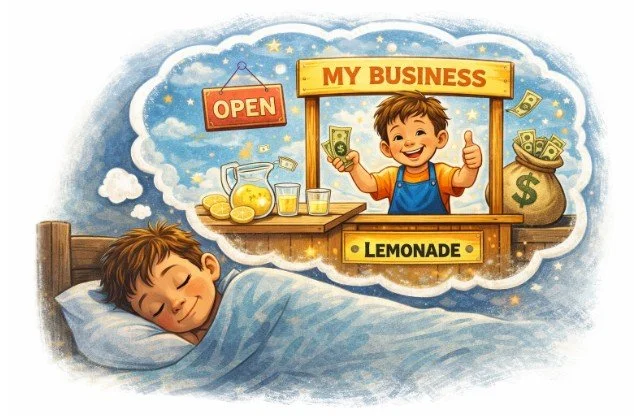
I hope that little conversation left my nine-year-old son dreaming about what’s possible.
C-ya tomorrow.